
The wake-up
“It helps me fall asleep, but it doesn’t keep me asleep.”
What changesA real dose at bedtime and a real half dose for the second half of the night: 150 mg elemental on the front, plus 75 mg on the half line for 3am.
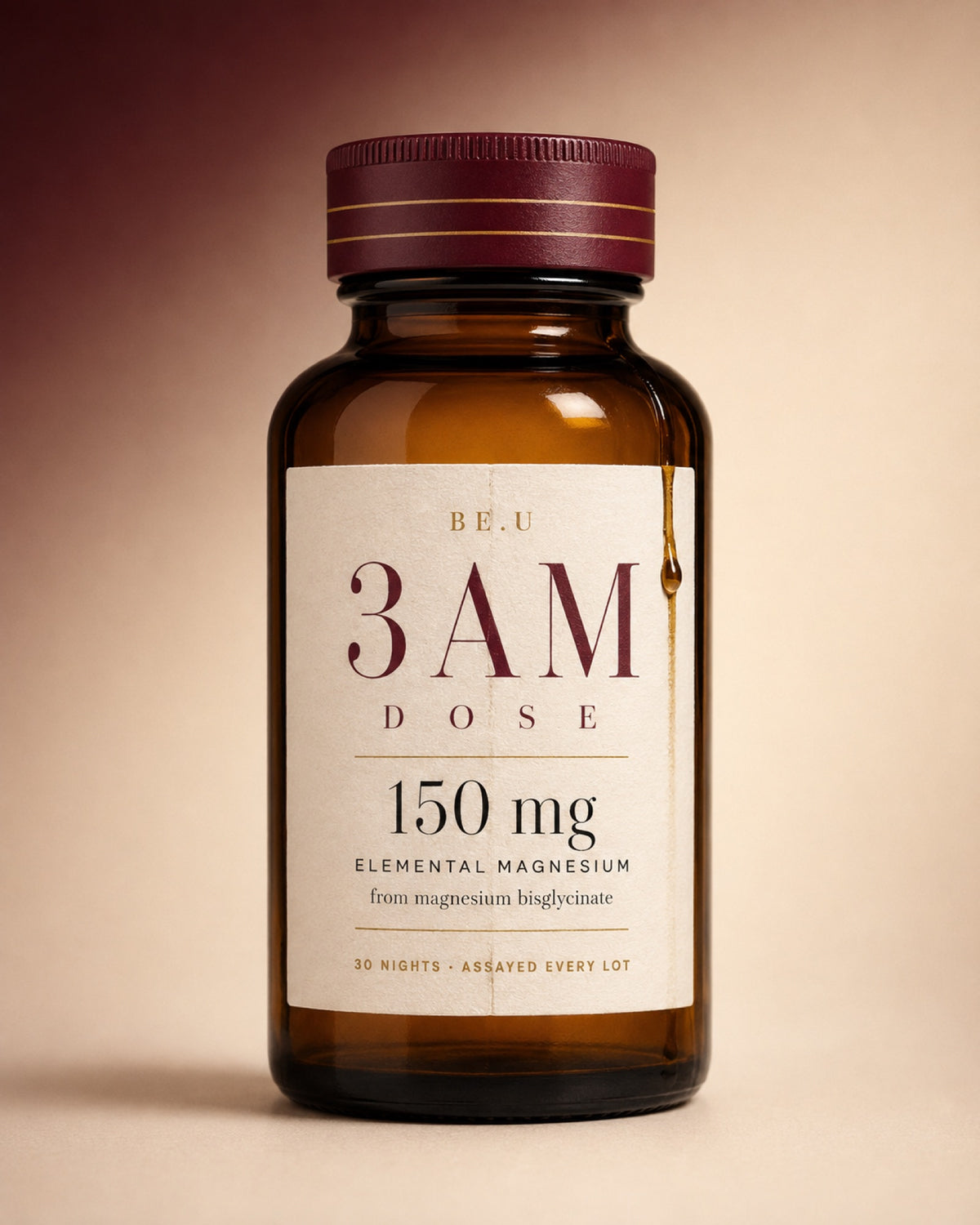
The front of the bottle, and the number that counts
A typical bisglycinate“400 mg” on the front
about 56 mgof magnesium
3AM Drops150 mg on the front
150 mgelemental, declared
Same shelf, same form of magnesium. One number is the molecule, the other is the mineral.


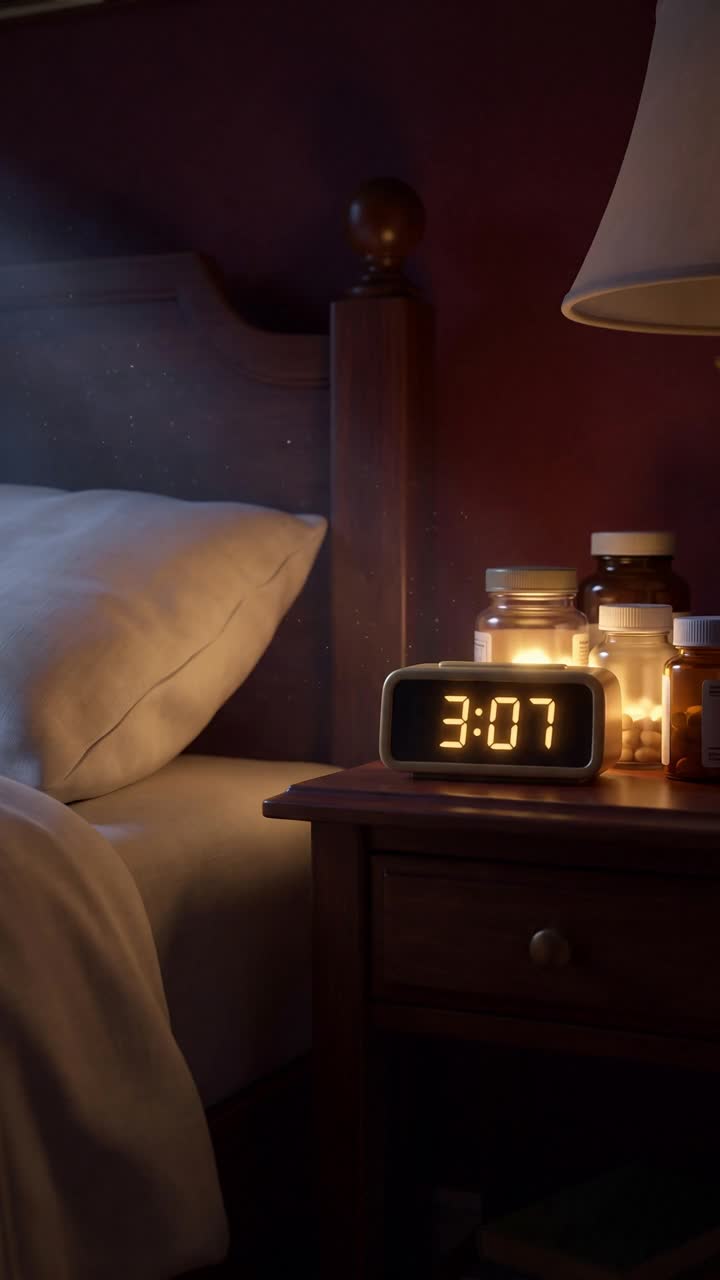
First run · 250 bottles
150 mg of elemental magnesium, printed right on the front. One full cap line at bedtime. A half line if 3am finds you awake.
Lot 001: 250 numbered bottles. The next lot ships 6 to 8 weeks after this one sells out.
Ships from our US warehouse. Order today and it arrives in about 5 business days, around the end of next week.
Secure, encrypted checkout
90 nights to decide. Refund, and you keep the bottle.
90-Night Trial, keep the bottle
Ships from the US in 5 days
Secure checkout
Charged once, nothing renews
Because the wake-up happens around six hours after bedtime, and what you swallow at 9 PM is not at its peak at 3am; melatonin, for example, has a published half-life of about 45 minutes. The industry’s answer is a second layer inside the tablet, a guess made six hours early.
Ours is a second dose you take only if the night asks for it, measured on the half line, with the whole night staying under the 350 mg supplemental limit.
150 mg of elemental magnesium, from about 1,060 mg of magnesium bisglycinate. About 0.9 g of glycine, from the bisglycinate chelate. Vitamin B6, with the exact amount printed on the Supplement Facts panel. Natural, sugar-free sweetener and flavor.
One full cap line (10 mL) at bedtime, straight or in a splash of water. The fill line is the whole instruction.
If your eyes snap open at 3:15, wide awake, take the half line: 75 mg, a teaspoon’s worth. Bottle on the nightstand, no light, no glass required.
Never more than one full plus one half dose in a night: 225 mg, under the 350 mg supplemental limit. Keep it two hours apart from osteoporosis medication or antibiotics. If you have kidney disease, talk to your doctor first.
Like the ocean. Not the pretty part: the mineral part, the way the air tastes on a beach before the sun comes up. It is saline and slightly bitter, and it is over in one swallow.
That much real mineral in that little liquid tastes like mineral. We would rather you taste the dose than taste the flavoring. Keep a glass of water on the nightstand and chase it.
Ninety nights from the day it arrives. If it did not work, if it upset your stomach, if you hated the taste, if you changed your mind: one email, full refund, and the bottle stays with you. No form, no return shipping, no questions about how much is left.
Left out: magnesium oxide, “buffered” magnesium, proprietary blends, added sugar.
The first run
Each one carries a lot number that matches the assay published here the day that lot ships. When the run sells out, the next lot ships when its own assay is back, about six to eight weeks later.
If 3am is not a problem you want to keep for another two months, the 3-pack is here today.
Start My 90-Night Trial
The 14% Trap
The number on the front is the weight of the molecule. The number that works is the elemental magnesium, and it lives in small print on the back, if it is printed at all.
14%
Magnesium bisglycinate is about 14% magnesium by weight. The other 86% is glycine, the amino acid the mineral rides in on.
56 mg
What a “400 mg” gummy works out to, in magnesium that counts.
Calculated at 14.1%, the share of magnesium in magnesium bisglycinate.

One night, two halves
You fall asleep because you are exhausted, then at 3am you are tired but wired.
The 9 PM bet
Every sleep aid you have ever tried was a bet placed at 9 PM, six hours before the problem happens.
Melatonin peaks in about an hour and has a half-life of about 45 minutes. By 2am, less than 2% of the peak is left.
The night has two halves
The second dose
The full line at bedtime. Elemental magnesium, printed on the front.
The half line, measured in the dark. Only if you wake.
Never more than two doses in one night: 225 mg, under the 350 mg limit.
Lot-tested, then told
The numbers that decide it, and where each one comes from.
150 mg
elemental magnesium in the full line at bedtime, printed on the front
75 mg
on the half line, only if you wake
225 mg
the most in one night, under the 350 mg daily supplement limit set by the National Institutes of Health
90
nights to decide. Refund, and you keep the bottle.
Never more than one full plus one half dose in a night. That limit is printed on the bottle.
Every bottle carries a lot number, and the elemental magnesium in that lot is measured by an independent laboratory (ICP-OES). The assay is published here, with the lot number, before the lot ships.
Lot 001 · certificate of analysis
Certificate of analysis for the lot on your bottle: lot number, elemental magnesium measured per dose (ICP-OES), heavy metals, microbiology, laboratory name and date.
Before 3AM Drops
The wake-up
“It helps me fall asleep, but it doesn’t keep me asleep.”
What changesA real dose at bedtime and a real half dose for the second half of the night: 150 mg elemental on the front, plus 75 mg on the half line for 3am.
The pills
“The tablets are huge. Almost impossible to swallow.”
What changesOne measured dose, ten seconds, no choking, no size-00 capsules, nothing to cut in half.
The math
“I have to take 2 to get the 300 mg daily.”
What changesElemental milligrams on the front, compound in parentheses on the panel, one dose equals one number.
The glycine
“Look into glycine. When I take it, I am able to fall back asleep quickly after waking up at night.”
What changesThe glycine comes along, just under a gram in every bedtime dose, the amino acid with its own sleep research.
Quotes from public reviews and forums about other magnesium and sleep products, collected in our research. None of them are about 3AM Drops.
Real reviews, similar dose
Verified buyers of other magnesium glycinate products at 120 to 200 mg per serving, the same range as the 150 mg on our front. Copied word for word, the critical ones included.
“I’ve tried many different brands, but I’ve found Trace to be the most effective, and in particular this liquid magnesium glycinate. I’m 57, 5 years into menopause and I sleep like a fat baby! The taste is sweet and mild.”
“My panic attacks are severely reduced and I’m able to sleep through more nights without being woken up by my cortisol alarm clock at 3AM.”
“Works fine, just has a bit of salty flavor which some sensitive people may not care for. I however love salt”
“As a 41-year-old mom of three taking D3/K2, I was constantly hitting a wall and feeling exhausted mid-day. Adding this Magnesium Glycinate to my nighttime routine made an absolute world of difference! It helps me fall asleep smoothly at night, and surprisingly, that afternoon crash is completely gone.”
“I keep this bottle next to the nightstand as part of a boring wind-down: lights down, phone away, capsule with water. Glycinate has sat easier for me than the cheap oxide bottles that turned into a bathroom schedule. … Not promising miracles; just a steady habit that fits how we actually live.”
“It was ok but I would recommend it if you only take it occasionally because it crystallizes and it becomes like little pebbles inside the liquid and it makes me gag.”
“I just received the pure brand Magnesium glycinate 120mg three days ago and I’m truly already feeling the difference. … I’m also finding that I’m getting better sleep as well. … its easy on the stomach and it’s not overly expensive”
“This liquid magnesium glycinate did not disappoint. … I make a little tart cherry "mocktail" in the evenings and add this to it along with saffron extract and it helps with anxiety and sleep for me. So happy with it!”
“These are by far the best Magnesium Glycinate pills I could find, no microcrystalline cellulose, so they don't affect my digestive system,high dose (120 mg elemental magnessium), very effective for sleep, but unfortunately the capsules are almost too large to swallow.”
“Definitely helps with sleep; I usually move around a lot in my sleep, constantly waking up but I sleep like a baby when I take these. I just wish they were in capsule form. They can be very hard to take sometimes.”
“I’ve had sleep issues for a couple decades and at one point years ago had a prescription for sleep medication but since switching to magnesium, I’ve never taken another sleep aid. … The tablets are what I’d consider medium sized and a bit dry so no easy to swallow coating.”
“This tablet is way too large and chalky. … It does seem like a very good brand as it did give me a good night's sleep and I read a lot of good things about it.”
“Great brand and great product and quality. It helps me to relax at night for better sleep and I stopped getting leg pains during the night.”
“Every time i take it, i get such good sleep, muscles are more relaxed and less carpal tunnel and tingly fingers”
Swipe for all 14 reviews. Reviews of other brands, shown for their dose, not as reviews of 3AM Drops. Individual experiences; results vary.
Check your bottle
Go get the bottle in your drawer. Turn it around, find the Supplement Facts panel, and look for the word “elemental.” If it is not there, multiply the front number by 0.14. That is what you have been taking.
| Compared | 3AM Drops | A “400 mg” gummy | A “2,000 mg” nootropic |
|---|---|---|---|
| What the front says | 150 mg elemental | 400 mg | 2,000 mg |
| Magnesium that counts | 150 mg | about 56 mg | 145 mg |
| Per serving | One cap line | 2 gummies | 3 capsules |
| Elemental on the front | |||
| A measured dose for 3 AM |
Elemental figures come from each product’s Supplement Facts panel, or are calculated at 14.1% when only the compound weight is printed.
The 90-Night Trial
If you’re not sleeping through the night better, email us and we refund every penny, and you keep the bottle. No forms, no return shipping, no hoops.
Ninety nights, not thirty, because magnesium builds and because we would rather you finish the bottle than watch the calendar.
Start My 90-Night Trial
Why it exists
“Our mothers had not failed magnesium. They had been sold a number that was not the number.”
Our mothers are the reason this exists. Two of them, in two different cities in Brazil, both waking up somewhere around three in the morning, both for years. They had both tried magnesium. There was a bottle in each drawer.
The night we finally turned those bottles around and read the panels, neither printed the word “elemental.” One was delivering about 56 mg a night.
So we went and made the bottle we wanted them to have: the real figure on the front, and a second measured dose for the hour that was actually waking them up. It tastes like the sea, and we decided we would rather explain that than dilute it.
Matheus & DaviFounders, be.u
The deal for the first runOn night 14, we send you one email with one question. Your answer, in your own words, is what goes on this page. Until then, the proof is the certificate above and the 90 nights. We would rather earn the wall than write it.
Start My 90-Night TrialStart your 90 nights
Lot 001: 250 numbered bottles. The next lot ships 6 to 8 weeks after this one sells out.
| Supply | Nights | You pay | Per night | You save | Shipping |
|---|---|---|---|---|---|
| One bottle | 30 | $45 | $1.50 | None | $4.90 |
| Three bottles | 90 | $115 | $1.28 | $20 | Free |
| Six bottles | 180 | $199 | $1.11 | $71 | Free |
The 3-pack is the one to start with. Magnesium builds over weeks, the trial runs 90 nights, and 90 nights is three bottles.
With one bottle$79 of value, $45 today
Both guides arrive by email the moment your order is confirmed.
Your order is confirmed and both guides land in your inbox.
A lot number that matches the assay published here the day that lot ships.
Not sleeping through the night better? Email us. Refund, and you keep the bottle.
Charged once. No subscription, no second charge.
Before you buy
150 mg at bedtime. 75 mg at 3am, if the night asks. Declared on the front, every lot tested.
Start My 90-Night TrialCharged once. Nothing renews.
Check the old bottle. If the front says “400 mg” or “500 mg” and the panel does not say “elemental,” you took about 14% of that number, 56 to 70 mg, a fraction of any studied dose. That is the usual reason “it did nothing.”
The nightmares are real for a small minority, usually at full dose on an empty stomach; the 3AM Protocol starts you at a half dose, with food, for three nights.
Because 150 mg is what fits in a bottle without lying on the front. Magnesium bisglycinate dissolves at 10 to 15 mg of elemental magnesium per mL, so a real 150 mg is already a 10 mL line; brands printing “400 mg” or “500 mg” on a tiny dropper are printing the weight of the molecule, or a number that physically cannot fit.
Take the half line at 3am and your night adds up to 225 mg, every milligram measured and real.
If you “rolled my eyes every time someone in here said magnesium changed their life,” good. It is not a medicine. It does not replace hormones or medication, and it does not work for everyone. The research behind it is modest, not miraculous.
What it does is give you a real, honestly labeled dose, in a form you can take at 3am, with 90 nights to find out. If it is not your answer, you keep the bottle and your money.
Bisglycinate is the form chosen because it does not pull water into the gut the way citrate and oxide do. The “serious diarrhea the next morning” reviews belong to citrate powders. No citrate, no oxide in 3AM Drops.
Ask your pharmacist; we are not your doctor. The known interactions are about timing: keep magnesium two hours away from osteoporosis medication and certain antibiotics, and mention it if you take a diuretic. A night dose usually spaces itself from morning medications. If you have kidney disease, talk to your doctor before any magnesium supplement.
One woman in our research put it this way: “It is so pronounced, I sometimes wonder if I’m losing my mind.” You are not, and you are not exaggerating. Waking at 3am wired is one of the most common complaints in the years around menopause, and being told to try yoga and drink less wine is not an answer.
Magnesium does not change your hormones; that is a conversation for your doctor. It gives the part of your nervous system that acts as the brake the mineral it runs on, at a real dose, alongside whatever your doctor prescribes.
One dose is a sip, not a glass. If you already get up twice a night to pee, some of those wake-ups are the bladder, not the brain. The tell: waking with the urge is the bladder; eyes snapping open with a racing mind and no urge is the wake-up this dose was made for.
Count real milligrams. A bottle holds thirty 150 mg bedtime doses plus about ten 75 mg half doses: 5,250 mg of elemental magnesium, about $0.009 per milligram. A $20 bottle of “400 mg” gummies delivers about 1,680 mg a month, about $0.012 per milligram, and never gets past 56 mg a night. The cheaper bottle costs more per milligram that counts.
That is what the 90-Night Trial is for. Email us, we refund every penny, you keep the bottle.
Every order ships from our warehouse in the US and arrives in about 5 business days. You get a tracking link by email the day it leaves. The 90 nights start counting the day it arrives, not the day you order.
Lot 001 is 250 numbered bottles. When it is gone, the next lot is made, sent to the independent lab, and only ships once its own assay is published here. That takes about 6 to 8 weeks. If you want to start now, this lot is the one that ships now.
On the label
3AM Drops, in plain terms.
These statements have not been evaluated by the Food and Drug Administration. This product is not intended to diagnose, treat, cure, or prevent any disease. Results vary. Best results with consistent nightly use over 2 to 3 weeks.
Product facts
These statements have not been evaluated by the Food and Drug Administration. This product is not intended to diagnose, treat, cure, or prevent any disease.
Your cart is currently empty.