
Hair after 45
Two Kinds Of Hair End Up In Your Brush.
Only one of them came out at the root.
Why the clarifying scrub stops working by Thursday, why the supplement did nothing, and what your dermatologist actually means when she says your labs are normal.
Go and get your hairbrush. This takes ten seconds and it is the most useful thing you will do about your hair this month.
Pull the hair out of it and spread it across something pale. A tissue, the edge of the sink, anything. Now look at the ends.
Go and get your hairbrush. This takes ten seconds and it is the most useful thing you will do about your hair this month.
Two piles. Two completely different problems.
Almost every product you have ever bought for your hair was built for the first pile. Very little on the shelf is aimed at the second, and nobody sat you down and explained the difference.
If you have already been to a doctor about this, you probably heard some version of the same three words. Stress. Aging. Hormones.
Your bloodwork came back normal, you were told it was normal, and you walked out with an explanation that explained nothing.
So let me give you the version nobody gave you. It takes about four minutes to read and it will change what you buy next.
The ten second test
Full length, pale bulb
A tiny bulb at one end, about the size of a pin head.
Came out at the rootShorter, no bulb
A blunt or slightly frayed end where it gave way.
Broke along the strandI was dismissed so many times, told it was stress, aging, or "just being a woman." From the research behind this page
How this started
I spent a long stretch of last year reading what women in their forties and fifties actually write to each other about their hair. Not reviews. The other places. The threads posted at eleven at night where nobody is selling anything and nobody is performing.
They are hard to read.
That last habit came up again and again, and it is the one I think about most: women scrolling back through old photographs, not for the memory, trying to work out exactly when it started.
And then one woman wrote a sentence that stopped me, because she was correcting something before anyone had even said it to her:
She was defending herself. Somewhere along the line she had been told, or had read, that thinning hair means damaged hair, and she knew that was not her. No bleach. No daily flat iron. She had already ruled it out and she was right to.
I sat with that for a while, because she was right and she was also missing something, and the thing she was missing was not her fault. It is barely written down anywhere a normal person would find it.
Hair shaft diameter climbs until roughly the age of forty to forty-five. Then it falls. The fiber itself gets thinner, it carries fewer cuticle layers, and its tensile strength drops measurably. That is published, peer-reviewed work, repeated across several independent papers. It is not a brand's theory and it is not something anyone is trying to sell you.
Read her sentence again with that in your hand.
She is right that it is not damage. Damage is what bleach and a daily flat iron do, and she was doing neither. But her hair could still be breaking, because the fiber is simply thinner than it was, and thinner fiber snaps under things that never used to break it. The same brush. The same ponytail. The same wash day she has done since she was twenty-five.
Nothing she did caused it. Nothing she stopped doing would fix it. And nothing she had been buying was aimed at it.
The lists were almost interchangeable, house to house. Rosemary oil, nothing. Hair vitamins at forty to a hundred dollars a month, nothing. A serum that worked for a while and then stopped. A clarifying scrub that felt incredible for about a week. One woman totalled it up and landed on the sentence that shows up more than any other in this entire category: "it once again just turned out to be a waste of money."
They were not bad products. Most of them do roughly what they claim. They were all aimed at the same pile.
The sentence that stopped me
- "shower drain full of hair… typing this as I pick hair off my sweater."
- "I became hyper fixated on my thinning hair, my widening part and my self esteem got worse."
- "It's hard not to hyperfixate on it and obsess over looking at photos of my hair."
- "I'm 57 and feel as though this is aging me big time."
I don't use harsh chemicals or excessive heat, so I know this isn't structural hair damage. The sentence this whole page is built on
What I went looking for, and what I found
Then I asked what they had already tried
The race everybody is running
Line up what is actually for sale for thinning hair after forty-five and something jumps out.
One spot on your head.
Every one of those is an argument about how to reach the follicle. The whole industry is running one race, in one direction.
And here is the uncomfortable part. The follicle is the half you cannot change without a prescription.
As estrogen falls, the growth phase of your hair cycle gets shorter and the hormonal balance at the follicle shifts. Follicles gradually start producing finer hair than they used to. Over years, that is what widens a part.
This is also exactly why your labs came back normal. In most women with pattern thinning the hormone levels in your blood are perfectly fine. What changed is how sensitive the follicles are to those hormones, and a standard blood panel does not measure that. You were not imagining it, and your doctor was not lying to you. The test simply does not look at the thing you were asking about.
Everything above happens at the root. Meanwhile, something else is happening along the length of the hair you already have, and it is the second pile in your brush.
The fiber thins with age. Thinner fiber breaks. Every strand that snaps halfway down is volume you lost without losing a single follicle.
You count that hair. Of course you do, it is in your hands. You file it under "my hair is falling out," and you go and buy another product aimed at the root, and the second pile keeps growing.
Two losses. One of them is not yours to fix. The other one is, and nobody ever taught you to look for it.
Your scalp is skin, and it behaves like skin. Oil oxidises. Residue collects around the opening each hair comes out of. Women describe it precisely: "about a year ago i started noticing my scalp was feeling very sticky & waxy… i'm desperate, & i've tried just about everything." And: "Every time I scratch my head, I end up with this gross white buildup underneath my fingernails… even right after shampooing."
You have probably already discovered that a good clarifying scrub fixes that. For about a week. "helps remove buildup, but it comes back within the same amount of time."
Of course it does. It was a one-off cleaning of something that reaccumulates on a schedule. It was never a protocol. That is not a flaw in the scrub, it is a flaw in using it like an event instead of like a habit.
Every product here points at the same spot
Part one: the half that is not yours to fix
This half is hormonal, and no serum, shampoo or supplement changes it.
Anyone telling you otherwise is selling you something.
Part two: the half nobody put a name on
And a third thing, sitting on top of both
Clear and Keep
That was the entire design brief.
Clear & Keep is a two-minute step you do before you wash, twice a week. You put it on dry hair along the partings, work it in for two minutes, then shower and wash exactly the way you already do. It rinses out. There is nothing to do on the other five days.
There is one more thing worth thirty seconds, because it is what separates this from the pre-wash bottle sitting next to it on the shelf.
Most pre-wash treatments are oils. Pumpkin seed, argan, jojoba, sweet almond, babassu. They go onto the scalp and they stay there until you wash them out.
Now remember what that yeast eats. Those are precisely the fats it can use.
Opposite direction, identical slot.
One thing you cannot change, and two you can
It clears
Salicylic acid is a beta hydroxy acid, and that one letter is the whole point on a scalp. Beta means oil-soluble. It can get into an oily follicle opening instead of rinsing over the top of it, which is what a water-soluble acid does. Beside it, piroctone olamine holds down the yeast behind the flaking and the itch. That yeast has one useful weakness: it cannot manufacture its own fats, so it lives entirely on the ones it is handed.
It keeps
Panthenol does not sit on top of the hair. It goes in. Spectroscopic work published this year traced it into the cortical protein of the fiber, where it hydrogen-bonds with the hair's own protein and raises the strand's break stress and elasticity above untreated hair. In plain terms: a more elastic strand bends where a brittle one snaps.
Why it rinses off instead of soaking in
Same two minutes. Opposite direction.
A pre-wash oil
Puts fat onto the scalp and leaves it there until you wash.
Feeds itClear & Keep
Lifts the oil and residue off, then rinses away with your shampoo.
Takes it offWhat to expect
This is the part most brands will not put in writing, and it is the part you should hold us to. Here is what is realistic, and how to check it yourself.
That is the whole honest arc. Not a before-and-after photograph, and not a number we invented.
There is a specific woman I want to speak to directly, because nobody else does.
You started a treatment three or four months ago. You are still taking it. You are doing everything right. And it has not visibly done anything yet, and you have been told to give it six months to a year, and every wash day in between is its own small event.
Nothing here asks you to stop. This does not act on the growth cycle, so it does not compete with what you are already on and there is no shedding phase to go through. What it does is work on the two things that change on a scale of weeks rather than a scale of seasons, while you wait out the thing that changes slowly.
What to expect
It will not give you new hair. It does not touch your hormones, and it is not a replacement for anything your doctor has you on.
If what you are hoping for is the thing women describe as "a bunch of little baby hairs about an inch long" filling in along the part, that is a growth-cycle outcome, and this is not a growth product. Buying it for that will disappoint you and I would rather say so now than take your money.
And if your thinning arrived suddenly in patches, if your hairline is receding in a smooth shiny band, or if you are losing eyebrow hair, please see a doctor before you buy anything at all. Those are different conditions, and waiting costs ground that does not come back.
That is a considerably smaller promise than the one you have been reading everywhere else.
It is also the one that is true.
What actually happens, week by week
On your scalp
The fastest thing to change and the easiest to feel. Less flaking on your shoulders. Less of that itch you stopped noticing because it has been there for a year. And it does not feel waxy again by the third day after washing.
In your brush
Go back and do the ten-second test from the top of this page. You are not looking for less hair overall. You are looking for fewer of the short pieces without a bulb. The full-length strands with the pale bulb are shedding, and this product does not change those. The short ones snapped, and those are the ones on the table.
At the ends and in your ponytail
Less snapping when you brush it out. Fewer flyaway broken ends standing up along the part. The ponytail feels a little less like it is getting away from you.
If you are already four months into something else
What is in it
- Salicylic acid. Oil-soluble, so it works inside the follicle opening. Clears the residue and oxidised sebum a shampoo passes straight over.
- Piroctone olamine. Holds down the yeast behind flaking and itch. A cosmetic active with decades of use behind it.
- Panthenol. Penetrates the fiber, bonds with hair protein, raises elasticity so the strand bends instead of breaking.
- No oils, no butters, no silicones, no fragrance. Not because those are bad, but because on a scalp we are trying to clear, an occlusive layer works directly against the job.
And here is what it will not do
Start here
Pre-wash scalp serum. One bottle is sixteen applications, which is eight weeks of the twice-weekly protocol.
The review sentence that follows this whole category around is "This is very expensive product for little to no results." The second half of that sentence is what the guarantee below is for. The first half we can settle right now: forty-nine dollars, one time.
Nothing renews. No subscription, no second charge in six weeks, nothing to cancel. That is in writing because it is the single loudest complaint in everything women wrote about this category: "make sure you cancel your subscription, or dont even sign up for one… they wont refund you cause its discounted." We are not going to do that to you.
Go back and look at that brush one more time.
The short pieces without a bulb are going to keep collecting whether or not you buy anything, because thinner fiber keeps snapping under a brush that has not changed. That is not a scare tactic and it is not a countdown. It is just what happens on a Tuesday, quietly, in a way that never shows up as a single dramatic moment you could point at.
Eight weeks from now you will either have been measuring that pile or you will still be squinting at your part under the bathroom light, trying to decide whether it looks worse than last month.
Nobody can promise you that, and I am not going to. What I can hand you is the half of this that was always yours to change, two minutes at a time, twice a week.
be.u Clear & Keep
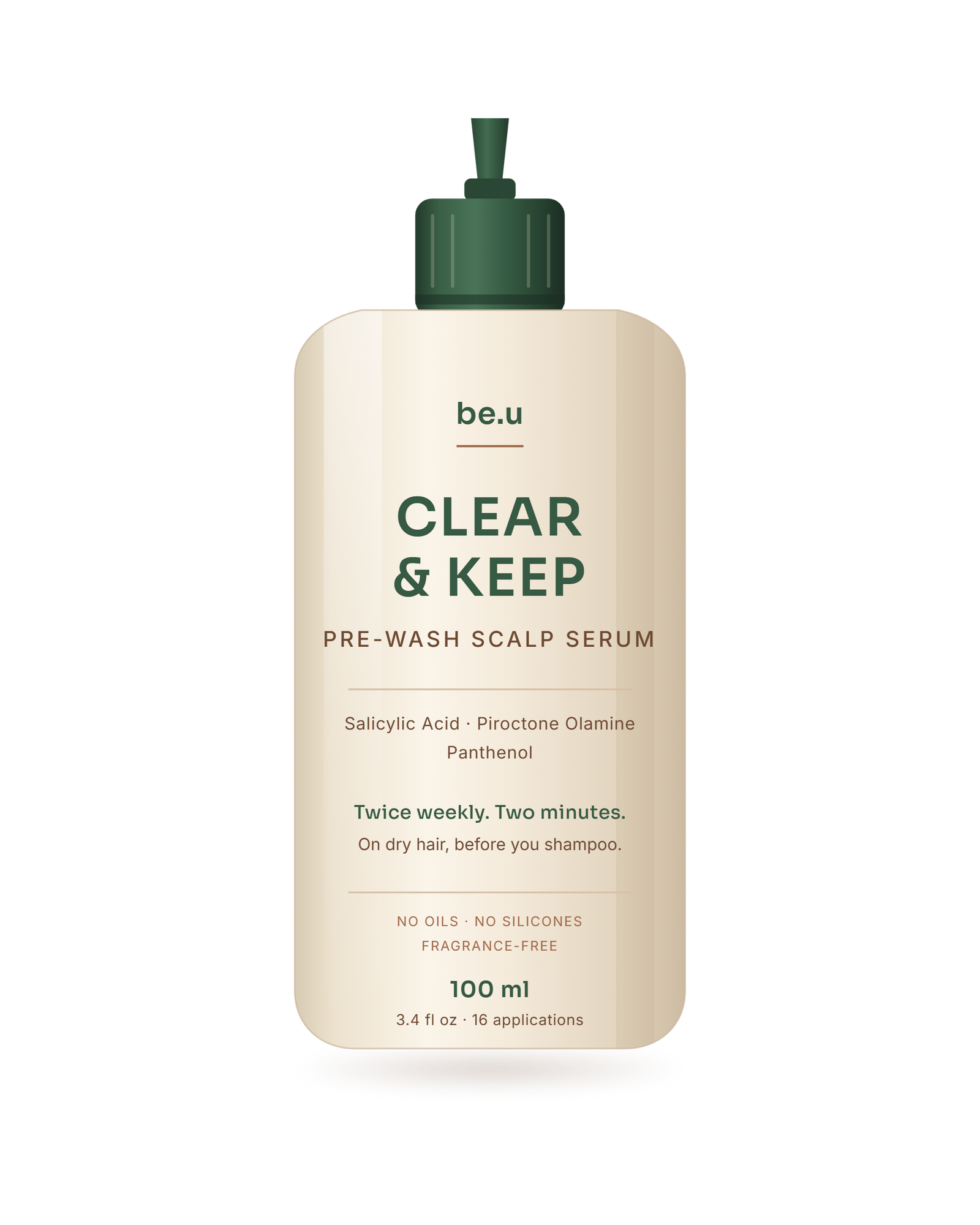
-
Clear & Keep pre-wash scalp serum
Eight weeks of the twice-weekly protocol. $49 -
The Two-Loss Map
The ten-second brush test written out properly, plus the part test and the ponytail-circumference test, with what each result means and what it does not. It tells you which of the two losses is doing more damage in your case before you spend another cent on anything. $19 value -
The 8-Week Wash-Day Calendar
Your sixteen applications laid against your actual wash days, with the week 2, week 4 and week 8 check-ins marked, so you are measuring instead of squinting at the mirror hoping. $12 value
The Two-Wash Promise
Use it twice. That is one week. If your scalp does not feel different, we refund you and you keep the bottle.
And if you finish the full eight weeks and your hair is not behaving any better, less snapping in the brush, less flaking on your shoulders, tell us any time inside 120 days. Same refund.
We are not going to argue with you about a bottle of serum. And we are not going to promise you new hair so we can sell you six of them.
Before you decide
I want to go back to how my life was. I want to have my confidence back. From the research behind this page
Refunded after two uses if your scalp does not feel different.